Huge heat wave impacts global weather
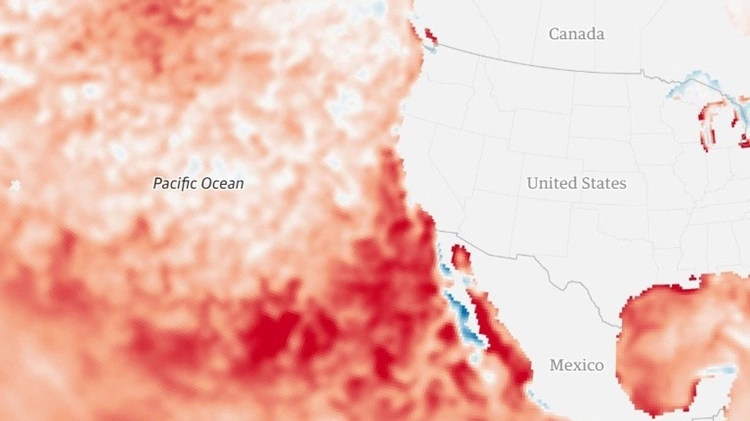
According to the Washington Post, the heat wave covers an area eight times the size of the United States in the Pacific Ocean, stretching from the Philippines to Peru, stretching north to Hawaii and California, and could have far-reaching impacts on weather phenomena globally in the coming weeks and months.
An ocean heat wave is a phenomenon where sea water temperature increases abnormally over a large area and lasts for a long time, near the surface or sometimes spreading to deep water. The giant Pacific heat wave formed when two separate heat waves combined, one in the North Pacific and one tied to a super El Nino developing along the equator.
Super storm Ba Vi in the western Pacific and the strong heat dome likely to form in the western United States in mid-July are the clearest examples of the strong impact of this heat wave. Drawing energy from warm ocean waters, the dangerous storm that passes near the Northern Mariana Islands north of Guam on July 6 local time could wreak havoc on Taiwan and China over the weekend. At the same time, thunderstorms from heat waves over the ocean can promote the formation of a heat dome thousands of kilometers away in mid-July, causing temperatures in the area to rise, leading to the risk of forest fires in northern New Mexico and Arizona, USA.
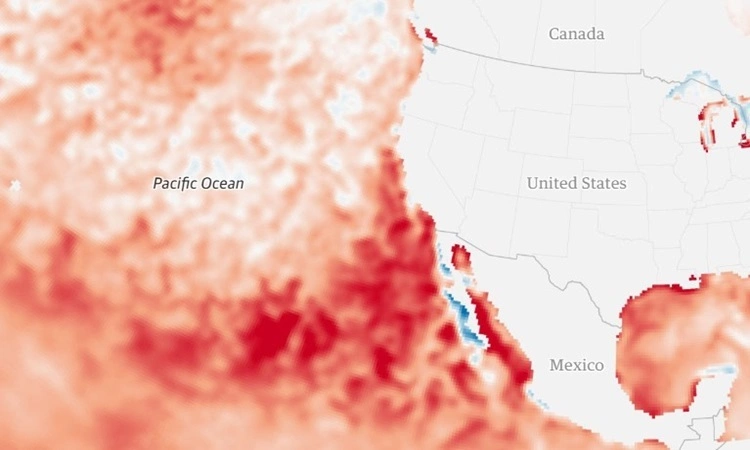
Climate scientist Daniel Swain predicts that warm waters in the Pacific will push sea levels up 15-60 cm near California, even reaching 60-90 cm under the influence of storm winds in the fall and winter, threatening to cause coastal flooding. The enormous amount of heat stretching across the Pacific Ocean will be released into the upper atmosphere, fueling the subtropical jet stream from fall to winter, increasing the likelihood of flooding and severe thunderstorms across the southeastern United States.
As ocean temperatures increase, evaporation becomes more intense, pumping more water vapor into the atmosphere. Winds circulating around high and low pressure areas carry excess wet water vapor thousands of kilometers away. A moisture-rich atmosphere will fuel storms, extreme rain and heat.
The current heat wave in the Pacific is related to a natural climate change called the Pacific Meridional Mode (PMM) that forms due to weaker winds and less water evaporation. According to the US National Oceanic and Atmospheric Administration (NOAA), PMM is an interaction phenomenon between the ocean and atmosphere in the Pacific Ocean. Unusually warm sea water temperatures in the subtropical Pacific reduce atmospheric pressure and weaken the trade winds, causing water evaporation to decrease, trapping more heat, leading to warm waters gradually expanding toward the equator.
Climate scientist Dillon Amaya emphasized that as El Nino continues to develop, it could combine with the PMM to create large thermal zones. These warm water masses are growing in both area and intensity under the impact of climate change.
According to Independent, the global ocean area experiencing heat waves has tripled, from 9% to more than 30% since the late 1980s. During that same period, the area covered by strong heat waves increased 6 times. Marine heat waves also spike during El Nino events. El Nino is the warm phase of the El Nino - Southern Oscillation (ENSO), which occurs every few years and is characterized by higher than average sea surface temperatures in the central and eastern Pacific Ocean.
During El Nino in early 2024, more than 46% of the global ocean area simultaneously experienced heat waves. According to the Guardian, in 2015, a long-lasting strong heat wave called "The Blob" appeared along with El Nino, causing a series of environmental and ecological impacts affecting millions of people in the Pacific coastal region.