Why do people like to watch robots fall?
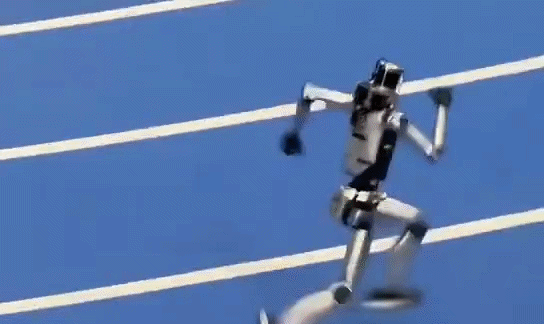
At the World Humanoid Robot Games (WHRG) in Beijing on August 22-26, the event is likened to the Humanoid Robot Olympics with more than 2,000 machines from 16 countries competing in many events such as running, soccer, table tennis and real-life job simulation tests. Many robots performed excellently, even breaking human records, for example, Tiangong Ultra completed the 100 m running distance in 8.64 seconds, far surpassing the world record of 9.58 seconds of famous athlete Usain Bolt.
However, the WHRG convention not only attracted viewers thanks to its impressive performances but also thanks to a series of humorous incidents. The robots staggered like drunk people or crashed into retaining walls, bringing viewers a burst of laughter.
"If the washing machine breaks down, no one laughs," Professor Dennis Hong, Director of the Robotics and Mechanics Laboratory at the University of California Los Angeles, told the Wall Street Journal. "But when the delivery robot slips and falls off the pier, or the humanoid robot falls on its face because of a wrong dance move, people not only find it funny but maybe even gloat a little like: See? Humans are still better."
Even Hong, who is diligently improving robots, finds joy in videos with titles like "Twitter ranks the funniest robot fails." "I laugh too. Some are really funny, if it weren't for our robots," he said.
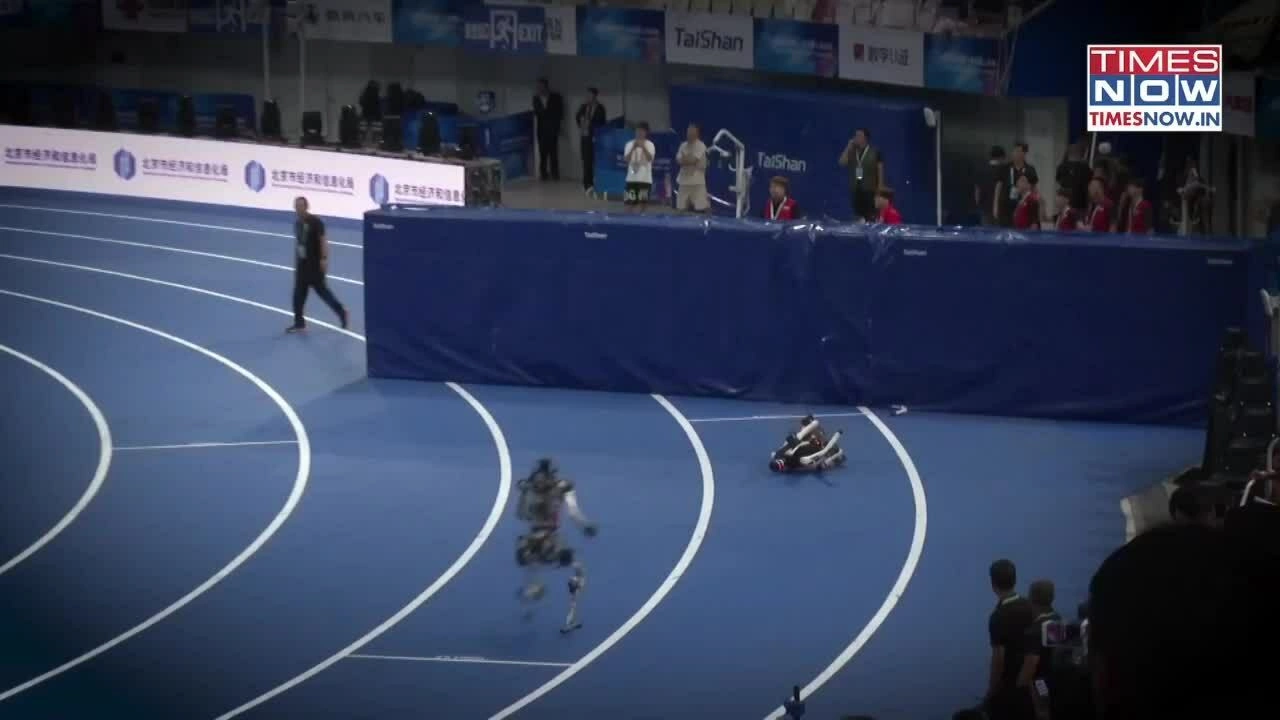
Changliu Liu, an associate professor from the Robotics Institute at Carnegie Mellon University, regularly shows students a video summarizing robot incidents on YouTube. The video begins with a humanoid robot walking down the stairs with confidence, but then misses a step and falls like a falling tree, its head flying off. Continuous laughter rang out, then exploded when a small robot wearing a football player's shirt missed the ball and fell backwards.
According to the Wall Street Journal, one of the elements that "attracts views" is the strange movement when the robot encounters a problem. Limbs that were programmed for specific movements swung around in an unexpected chaotic manner. The robot fell over without any reflex to defend itself.
In addition, Time said, the feeling of gloating over robot failures is motivated by fear about the future. Witnessing their shortcomings makes people feel that they are still a long way from being replaced by robots.
In many respects, this feeling is comparable to the joy when users see artificial intelligence make mistakes. The inability to spell the word "strawberry" once caused ChatGPT, the main AI chatbot of American company OpenAI, to be ridiculed across the Internet. With humanoid robots, this feeling is amplified when they are "clones" of humanity.
"I think there has been a change. Before, robots mainly brought excitement," Hong commented, adding that people who once eagerly awaited the "servants of the future" now see them as "potential attackers and job-stealers" and are on high alert.
Liu said she sees that anxiety evident at demonstration events, when some of the young people she wants to inspire are more interested in tricking machines. "When they do something that causes the robot to malfunction, they feel very proud of themselves," she said.
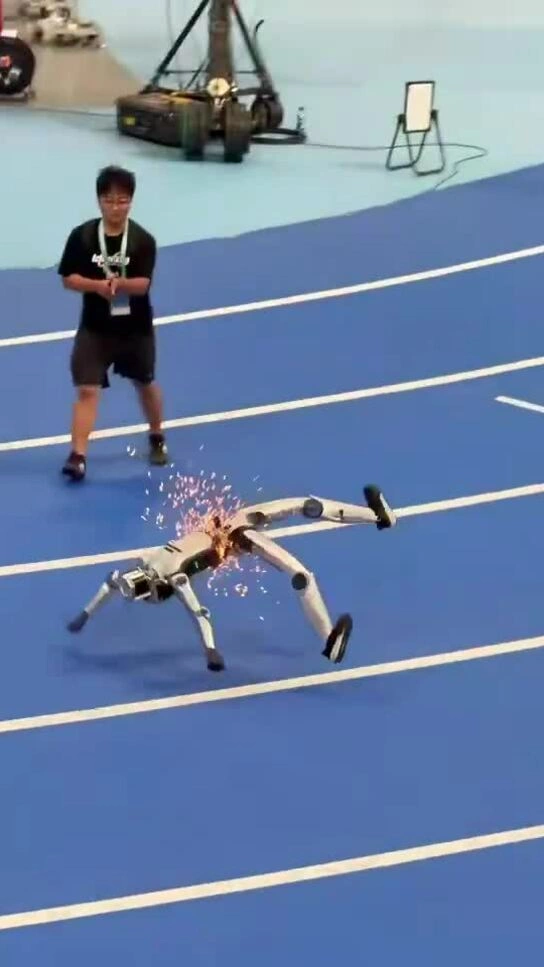
On social networks, the same thing happens with videos of broken robots. Late last month, the Breaking911 account posted on Twitter a video recording the incident of H1, a humanoid robot developed by Chinese company Unitree, while practicing for the WHRG convention. The machine crashed into the protective barrier, bounced off and fell on its back, its waist even sparking like fireworks.
The video attracted 21 million views in just one day. While some comments expressed amazement at the robot's ability to run, others mocked the machine's inability to stop when accelerating too much.
"The incident shows one of the technical challenges facing humanoid robots: speed is only useful if the machine can maintain balance, direction and control," Michael commented.
"Someday, these robots can replace us, but not today," commented Mario Nawfal.
However, not everyone watches robot malfunction videos just for fun. Professor Hong encourages students to embrace incidents as a way of learning, and to use seat belts and cushions on the floor when testing robots. Meanwhile, Liu watched the video not only to diagnose the cause of the problem, but also to consider what could be worse in a real-life environment.
One of the areas Liu focuses on is safety between humans and robots. The need for certification standards is growing, she said, as humanoid robots move beyond pre-programmed performances into the unpredictable world of humans. "When the robot left the stage and joined the crowd, the problem started," she said.
Hong and Liu's research will be essential when in the future, robots are expected to appear in homes, factories, farms, and even battlefields. In January this year, billionaire Elon Musk, CEO of Tesla, predicted that robots would become popular everywhere, creating a boom for the global economy. "My prediction is that there will be more robots than humans," Elon Musk said at the World Economic Forum (WEF) in Davos (Switzerland), while describing the world will have billions of robots, supporting many jobs including taking care of children and the elderly.
According to analysts at investment bank Barclays, the humanoid robot market is currently worth about $2-3 billion. Barclays predicts that the market will grow to at least $40 billion by 2035, possibly even up to $200 billion, as AI robots penetrate labor-intensive fields such as manufacturing. Investment bank Morgan Stanley predicts that by 2050, more than a billion humanoid robots will be in operation and the market could be worth $5 trillion.