Why did research on 'ghost particles' win the Nobel Prize in Physics?
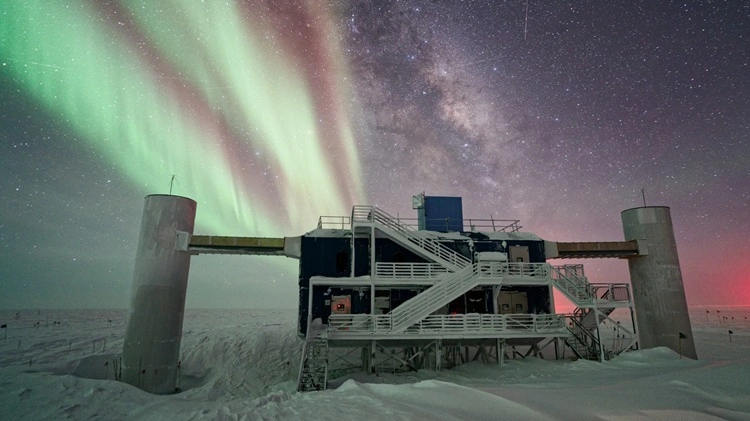
According to Space, the 2026 Nobel Prize in Physics was awarded to scientist Francis Halzen for discovering ghost particles from deep space using the IceCube Neutrino Observatory in Antarctica. Halzen's path to becoming a Nobel Prize winner began when he realized that the ice in Antarctica was an ideal environment to track neutrino particles on their journey from violent phenomena in space to Earth. This led to the birth of the IceCube Observatory, a 1 km³ wide ice block equipped with light sensors to help observe small rays of light emitted from the rare interactions between neutrinos and other particles.
Neutrinos are the second most common particles in the entire universe, after photons (light particles). Every second, about 100 trillion neutrinos pass through our bodies without us realizing it. If you're lucky, in 100 years, only one neutrino can interact with an atom in the human body. Due to their difficult-to-detect nature, neutrinos are nicknamed "ghost particles" because they carry absolutely no charge, have almost no mass, and move through the universe nearly as fast as the speed of light without hindrance.
High-energy neutrinos are believed to be emitted by powerful astronomical events that act as cosmic particle accelerators. Researchers consider neutrinos to be excellent messengers because they reach Earth without changing direction or losing energy and carry complete information. However, before we can better understand the astronomical event in deep space, scientists need to detect these high-energy ghost particles.
In 1988, Halzen first proposed the idea of hunting for neutrinos passing through Antarctic ice and randomly interacting with atoms. Antarctica is an ideal location for a detector because it has no sources of interference and is not affected by geological fluctuations due to earthquakes.
When a neutrino collides with the nucleus of an atom, the interaction creates an electrical charge and emits blue light that can be observed in water or ice. According to AFP, Halzen and his colleagues installed nearly 5,500 optical sensors one kilometer deep under the Antarctic ice to observe light from neutrinos passing through the Earth.
After initial testing, the IceCube Observatory was completed in 2011 and became the clearest demonstration of Halzen's theory. In August 2011 and 2012, scientists at the IceCube Observatory detected two extremely high-energy neutrinos (at the PeV level), nicknamed them "Bert" and "Ernie".
In November 2013, by improving data analysis methods, the research team reviewed and found another 26 high-energy neutrinos. Compared to the Large Hadron Collider (LHC), the most powerful human-made accelerator at the European Organization for Nuclear Research (CERN), high-energy neutrinos detected from space have energies from tens to millions of times greater.

A total of 28 of these particles (with energies ranging from 30 TeV to more than 1 PeV) are solid evidence that they come from distant cosmic sources and not from the Earth's atmosphere. This event officially opened the era of neutrino astronomy. Solving the mystery of the origin of neutrinos "could even reveal many other mysteries, such as the origin of extremely high-energy cosmic rays or dark matter," explains scientist Philipp Eller of the Technical University of Munich.
Today, IceCube continues to collect neutrino data, expanding our understanding of the universe and providing exciting opportunities to observe phenomena in deep space. "What IceCube did was open a new window to observe the universe," Juan Antonio Aguilar, a professor at the Free University of Brussels and member of the IceCube team, told AFP. "Its birth is similar to the first invention of the telescope, but works based on different elementary particles."
"Francis Halzen led an international team of researchers and engineers, bringing us an amazing tool. His perseverance and scientific vision paved the way for a new type of astronomy," commented Mark Pearce, Chairman of the Nobel Committee for Physics.