Why does the solar eclipse on August 12 look like it's moving backward?
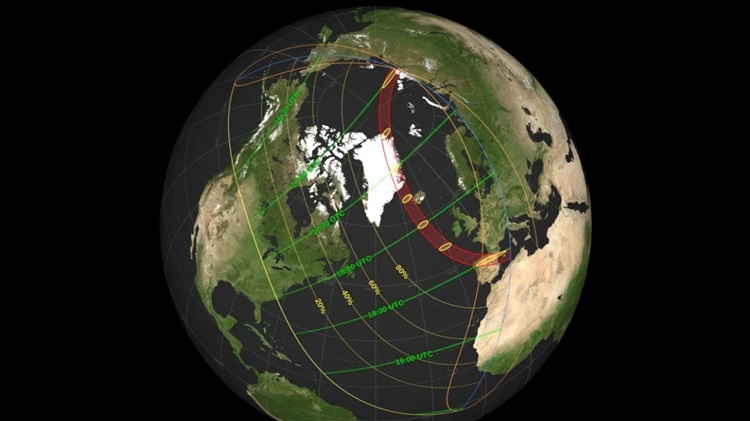
The total solar eclipse that took place on the night of August 12 and early morning of August 13 (Hanoi time) marked the first time in 27 years that Europe could observe this phenomenon. According to Space, the 293 km wide path of the region of totality "drawn" by the Moon's shadow on the Earth's surface, begins near Siberia in the Arctic Ocean and curves east to Greenland. From there, the route extends through western Iceland and northern Spain before crossing the Balearic Islands, ending in the Mediterranean Sea at sunset.
According to Live Science, during most total solar eclipses, the Moon's shadow on Earth often sweeps from west to east because the Moon's orbital speed is faster than the Earth's rotation speed. However, during the total solar eclipse on August 12, 2026, the eclipse's path on the map appeared to start in northernmost Siberia near the North Pole before heading east towards Greenland, appearing as if the Moon's shadow was moving from east to west, curving over western Iceland and northern Spain.
This reversal is a result of geometric effects and viewing the eclipse on a flat map instead of a sphere. The Moon's shadow moves in a smooth, continuous curve from west to east across the surface of the globe and practically does not change direction. When plotting the path of a solar eclipse close to the North Pole (from Siberia to Greenland) on a 2D plane, the map projection effect makes the path look like it is turning in reverse.
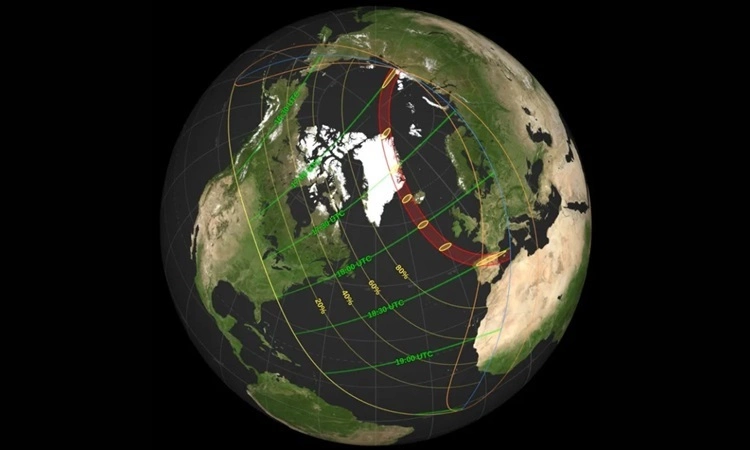
As explained by experts at NASA's Scientific Image Simulation Studio, the combined effect of Earth's rotation, Earth's axial tilt and the Moon's orbit causes the eclipse shadow to sweep across the North Pole in a wide curve, instead of the familiar west-to-east journey. On a flat map, that curve can create the illusion of the eclipse temporarily reversing direction.
A total solar eclipse occurs when the Moon is between the Earth and the Sun, temporarily obscuring the Sun's surface from view from the ground. When alignment occurs, the Moon casts a shadow along a line called the path of totality. Only places within this range can observe a total solar eclipse. Another factor to consider is that because the Moon has an elliptical orbit, sometimes it is closer to Earth than other times. A total solar eclipse only occurs when the Moon is at a sufficient distance from the Earth, making it appear the same size in the sky as the Sun (or even slightly larger). That obscures the glare from the Sun and reveals the star's corona.
The next total solar eclipse will take place on August 2, 2027 and will be visible across a 258 km wide path across southern Spain, northern Morocco, northern Algeria, northern Tunisia, northeastern Libya, central Egypt, the northeastern tip of Sudan, southwestern Saudi Arabia, Yemen and the northeastern tip of Somalia. Outside this path, most of Europe, much of Africa, the Middle East, Southeast Asia, eastern Canada and parts of the US state of Maine can see a partial eclipse. In North America, the next total solar eclipse will take place on March 30, 2033 and can be viewed from Alaska.