Why did Nvidia spend nearly 13 billion USD to buy Hugging Face?
On September 3, Nvidia announced the acquisition of Hugging Face, a platform that hosts large language models (LLMs) and databases, for $12.93 billion. According to Reuters, this is one of Nvidia's largest deals, helping to increase its influence in the booming open model market as well as increase the source of potential customers.
What is Hugging Face?
According to Fortune, Hugging Face, founded in 2016, is essentially a global hub for the AI development community, allowing programmers and researchers to share and use models, datasets, and applications. More than 18 million programmers, researchers and creators now use the platform to share more than three million models, 500,000 datasets and one million applications. More than 200,000 companies access the platform to explore, evaluate, customize, and deploy AI.
The important difference is that Hugging Face does not create a major AI model like OpenAI or Anthropic. Instead, the company provides an open platform for developers and organizations to build, share, test, and deploy models. Models can be downloaded, modified, and run on users' own infrastructure, depending on license and openness.
In 2023, Hugging Face was valued at 4.5 billion USD in a capital raising round of 235 million USD, receiving investments from Nvidia, Alphabet (Google's parent company), Amazon, Intel and Salesforce. According to the Financial Times, late last year, the platform rejected a $500 million capital investment offer from Nvidia, saying they did not want an investor with great influence who could influence their decisions.
Why does Nvidia value the open model?
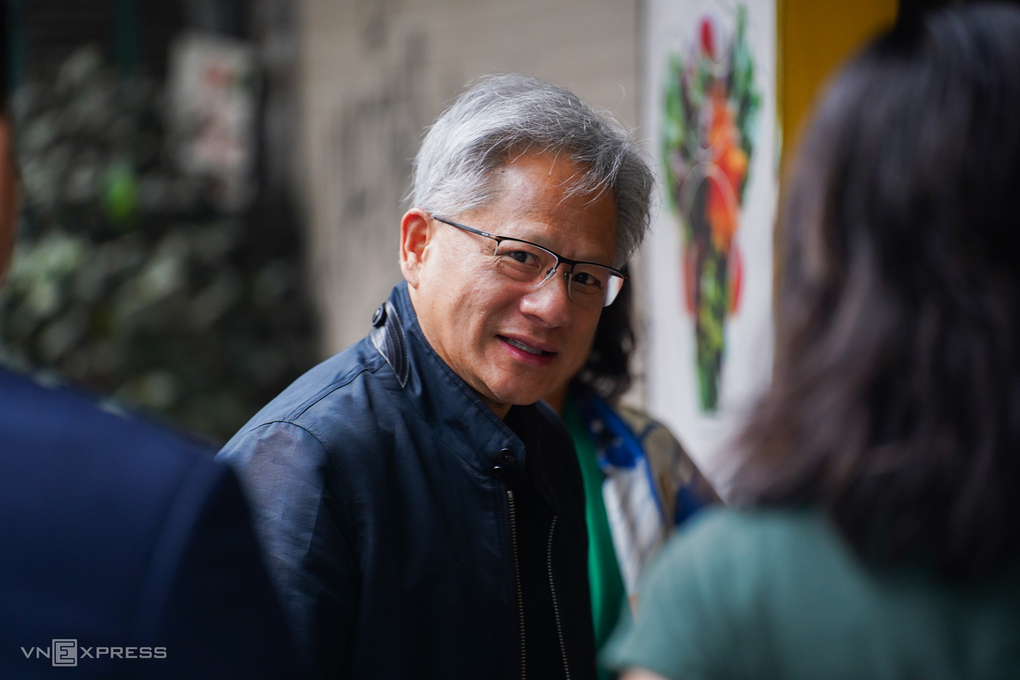
Although the US is famous for its advanced closed models like OpenAI's GPT or Anthropic's Claude, Nvidia CEO Jensen Huang believes the world needs both closed and open models. "There is no need for a monopoly versus open model, but a need for both monopoly and open," he said at Nvidia's annual GTC conference in March.
The open model is important, Mr. Huang argued, because it allows startups, researchers, universities, businesses and countries to develop based on AI instead of simply using technology through services controlled by a few companies. In a discussion last year, he compared the open model with notable open technologies such as Linux, Kubernetes, PyTorch and said that without them, startups and researchers would progress more slowly.
According to him, if strong models are made publicly available, many developers and countries can adapt them to their own needs, no longer completely dependent on a few monopoly suppliers. In July, in his first post on the social network Twitter, he shared a letter signed by many technology companies, which said that the open model helps "increase cybersecurity and safety, accelerate innovation and diffusion, and enable greater autonomy."
Nvidia itself also releases open models in many fields including inference, robotics, physical AI and biomedical AI.
What benefits does Nvidia benefit from buying Hugging Face?
According to Business Insider, acquiring Hugging Face allows Nvidia to control an open AI model hosting platform, consistent with the company's current operating strategy. "Open" can help avoid a market future dominated by giants like OpenAI and Anthropic, which create closed models. If that future happens and AI giants develop their own chips, like OpenAI which is creating the Jalapeno chip, they could finally knock Nvidia out of the game.
"Open platforms are an important counterweight to closed platforms. The more open and distributed AI development becomes across multiple models and developers, the more likely Nvidia is to maintain its role as an infrastructure provider," Brad Gastwirth, head of global market intelligence and research at Circular Technology, explained to Business Insider.
In a blog post on September 3, Jensen Huang affirmed that Hugging Face remains an open platform for the entire AI ecosystem. "Developers will choose for themselves the model, software framework, inference and cloud service provider, and computing platform they want," he wrote, adding that they are not forced to use Nvidia products.
However, it is estimated that Nvidia can still sell more chips thanks to the new deal. Developers using models from Hugging Face will have to choose the hardware and software to run them, and owning the platform gives Nvidia more influence over their decisions.
In addition, according to Maya Bakhai, founder of venture capital fund Spice Capital, deeper involvement in developers' workflows can help Nvidia better grasp new AI applications, such as for robotics.