#tinhtelookback: Wi-Fi 6 GHz can be used thanks to the new OS upgrade, the device is compliant

Wi-Fi 6 GHz starts to be used in Vietnam in 2026, from regulations, devices to software, but is still silent and waiting for new developments in 2027. The year 2026 marks a notable transition for Wi-Fi in Vietnam: the 6 GHz band begins to come into practice, opening up more space for high-speed wireless connections. However, instead of appearing through loud promotional campaigns, this process takes place quite silently, from frequency management regulations, device certification records to software updates. It wasn't until the second half of the year that clearer signs of 6 GHz Wi-Fi adoption began to appear. Information instructions:
From regulations to actual use
Wi-Fi 6 GHz is one of the notable changes in wireless network infrastructure in Vietnam in 2026. The frequency range 5925–6425 MHz, equivalent to 500 MHz of spectrum, is added for wireless internal network devices, creating more operating space besides the 2.4 GHz and 5 GHz bands that are already familiar to users.
![[IMG]](https://photo2.tinhte.vn/data/attachment-files/2026/09/9096368_wi-fi-6ghz.jpg)
The legal foundation for the use of this frequency band is set from 2025. Circular 01/2025/TT-BKHCN takes effect from May 15, 2025, supplementing regulations related to the use of the 6 GHz band for WLAN/RLAN. Meanwhile, QCVN 136:2025/BKHCN regulates technical requirements for 6 GHz radio access devices, with the mandatory application date determined to be January 1, 2027. Thus, 2026 becomes an important transition period between completing the legal corridor and putting technology into practical use. Although hardware supporting Wi-Fi 6E and Wi-Fi 7 has appeared on the international market before, users in Vietnam still have to wait for certification, software configuration and compatibility conditions to be completed.
First half of the year: Hardware is there but not really ready
In the first half of 2026, Wi-Fi 6 GHz has not yet made a noticeable change for the majority of Vietnamese users. Many phones, computers and routers already support Wi-Fi 6E or Wi-Fi 7 in hardware, but the ability to use the 6 GHz band depends on the regional configuration and certification status of each device.
![[IMG]](https://photo2.tinhte.vn/data/attachment-files/2024/10/8477205_gigabyte-wi-fi-7-2.jpg)
This is also the point where the conversion does not take place simultaneously. A device may support Wi-Fi 7, even have full hardware to connect in the 6 GHz band, but that does not mean the feature has been activated in Vietnam. For regular users, the difference is almost imperceptible. The router still broadcasts familiar Wi-Fi networks, phones and laptops still connect as before. The more important changes take place behind the scenes, in manufacturers' frequency management, device certification, and software configuration processes.
Q3 2026: First signs from certification data
By around the third quarter of 2026, certification and standards data will begin to show clearer movement of the device ecosystem supporting the 6 GHz band in Vietnam.
![[IMG]](https://photo2.tinhte.vn/data/attachment-files/2026/09/9096369_wi-fi-6e-6ghz-galaxy-s26.jpg)
In the mobile device group, Samsung Galaxy S26 FE and Motorola Fold are names recognized in market summary documents. This is a sign that devices capable of supporting new bands are starting to appear in data related to circulation in Vietnam. On computers, data about Wi-Fi modules also provides additional clues about hardware readiness. Recorded codes include Intel BE211D2W, BE200NGW, BE211NGW and AX211NGW; Realtek RTL8922AE, RTL8852CE; with MediaTek MT7925B14L.

In particular, modules from the Intel BE series and some Realtek and MediaTek modules support Wi-Fi 7, while AX211NGW and RTL8852CE belong to the Wi-Fi 6E group. Both generations can support connections in the 6 GHz band, depending on the device's configuration and deployment conditions. However, it is necessary to distinguish between a module appearing in certification data and the fact that every computer using that module can connect to 6 GHz in Vietnam. Actual usability still depends on the complete product configuration, firmware, operating system and corresponding frequency management requirements. Still, these data are noteworthy signs. They show that the story of Wi-Fi 6 GHz is no longer just about regulations or specifications announced by manufacturers, but has begun to be associated with specific devices in the distribution ecosystem in Vietnam.
Software becomes the key to opening the 6 GHz band
Another notable point in 2026 is the role of software. Not every device that wants to use 6 GHz Wi-Fi needs to change its hardware. For some phones and computers that already have compatible Wi-Fi chips, the limitation lies in the country-specific frequency management configuration of the operating system.
![[IMG]](https://photo2.tinhte.vn/data/attachment-files/2026/09/9105246_tp-link-archer-be600-7.jpg)
In 2026, new software versions such as iOS 27, macOS 27 Golden Gate or One UI 9 are expected to play an important role in updating regional support. When the frequency management configuration is adjusted properly, devices with compatible hardware can use the 6 GHz band without needing to replace it. This is especially meaningful for users who have invested in high-end phones, tablets or laptops in previous years. Instead of having to buy new equipment just to use one band, they can make better use of the hardware they already have. However, specific support needs to be confirmed by model and software version. Just because an operating system is updated does not mean that all compatible devices will automatically be 6 GHz unlocked in Vietnam.
The router has hardware support but has not been emphasized
While terminal devices are starting to have clearer movements, the router market presents another paradox: hardware supporting 6 GHz Wi-Fi has appeared, but this feature has not been widely promoted by manufacturers to Vietnamese users.
![[IMG]](https://photo2.tinhte.vn/data/attachment-files/2026/09/9105242_tp-link-archer-be600-1.jpg)
TP-Link Archer BE600 is a notable example. This is a tri-band Wi-Fi 7 router, supporting 2.4 GHz, 5 GHz and 6 GHz. According to compiled product information, the device has theoretical speeds of up to 9,700 Mbps on all three bands, with features such as Multi-Link Operation (MLO) and EasyMesh.
TP-Link Archer BE600 in hand: What's the difference when Wi-Fi 7 has an additional 6 GHz? TP-Link Archer BE600 exploits Wi-Fi 7 on all three bands 2.4, 5 and 6 GHz, supporting 320 MHz, MLO and wired network systems up to 10GbE. Over the past few years, Wi-Fi 6 has become a quite popular standard on laptops, phones and even... Tinhte.vn With such routers, the question is not only whether the device supports 6 GHz or not, but also whether the version sold in Vietnam allows using this band or not, how the firmware is configured and what users need to set up. The fact that the manufacturer has not emphasized 6 GHz in communications also makes it difficult for buyers to realize the value of this feature. Users may know that their router supports Wi-Fi 7 but may not understand that the device can exploit the additional 6 GHz band, provided the hardware, software and regional configuration are all suitable.
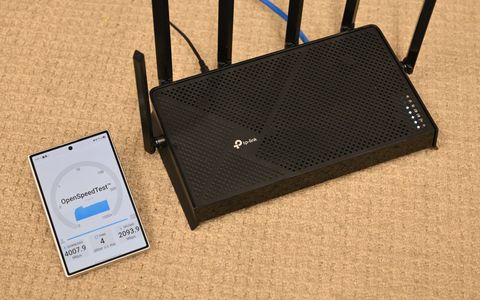
TP-Link Archer BE600 in hand: What's the difference when Wi-Fi 7 has an additional 6 GHz?

Besides, cost is also a barrier. Tri-band Wi-Fi 7 routers are still in the high-end segment, while most home users do not have an urgent need to upgrade if the current network still meets the needs of work, entertainment and gaming. Also because of its high segment, Wi-Fi 8 technology is also commercialized and has testing products to evaluate end device compatibility. Network operators also have an important role in the popularization process. When modems and Wi-Fi transmitters that come with Internet packages have not been upgraded simultaneously, it is difficult for users to take advantage of the new frequency band just by registering for a higher speed connection. FPT, Viettel or VNPT also have packages from 2 Gigabit to 10 Gigabit internet ready to provide optimal equipment for users. Therefore, although Wi-Fi 6 GHz has begun to have the necessary conditions for use, the actual experience still depends on both sides: the transmitter and the connecting device.
What to expect for 2027?
Looking back at 2026, Wi-Fi 6 GHz in Vietnam is not yet a transition that mass users can easily recognize. The most significant changes are behind the scenes: the legal corridor is completed, certification data begins to recognize more devices, compatible hardware becomes available on the market, and software gradually becomes the factor that helps enable the capabilities that are already available. The milestone of January 1, 2027, when QCVN 136:2025/BKHCN enters the mandatory application phase according to the roadmap, will be a milestone worth watching. As technical requirements and certifications are implemented more widely, the market has more basis to standardize 6 GHz band radio access devices. However, the standard does not automatically make 6 GHz Wi-Fi popular immediately. For this technology to truly reach many users, companies need to proactively introduce features, routers that support 6 GHz need to be more accessible, and network operators need to gradually introduce compatible devices into the home Internet infrastructure. If these conditions are met, 2027 could be the time when users start to pay more attention to taking advantage of the 6 GHz band, instead of just knowing about Wi-Fi 6E or Wi-Fi 7 by name and advertised speed. Wi-Fi 6 GHz is a prime example of how technology change sometimes doesn't start with a hit product or a big launch event. There are transitions that take time for regulations, hardware, software and infrastructure to be ready. 2026 may not be the time when Wi-Fi 6 GHz is popularized in Vietnam, but it is the year that marks important preparation steps for this technology to get closer to users' daily experiences.