VAR controversy 'is going too far' at the 2026 World Cup
In extra time in the match at Atlanta on June 29 in the round of 16 of the 2026 World Cup, midfielder Jonathan Tah headed the ball into the net for Paraguay, helping Germany lead 2-1. But after consulting Video Assistant Referee (VAR) technology, the goal was not recognized because it was determined that Waldemar Anton had fouled goalkeeper Orlando Gill earlier.
The slow motion shows that Anton had an impact from behind, causing Gill to fall just as Tah jumped high to head the ball. The level of collision was not large, causing many people to think that the referee's decision was too harsh. The match was then decided by penalty shootout and Germany lost.
On July 2, in the match between Belgium and Senegal, Belgium was awarded a penalty in overtime after VAR review and successfully came back. Also on the same day, in the match between the US and Bosnia & Herzegovina, US striker Folarin Balogun received a red card after VAR intervened and was judged controversially.
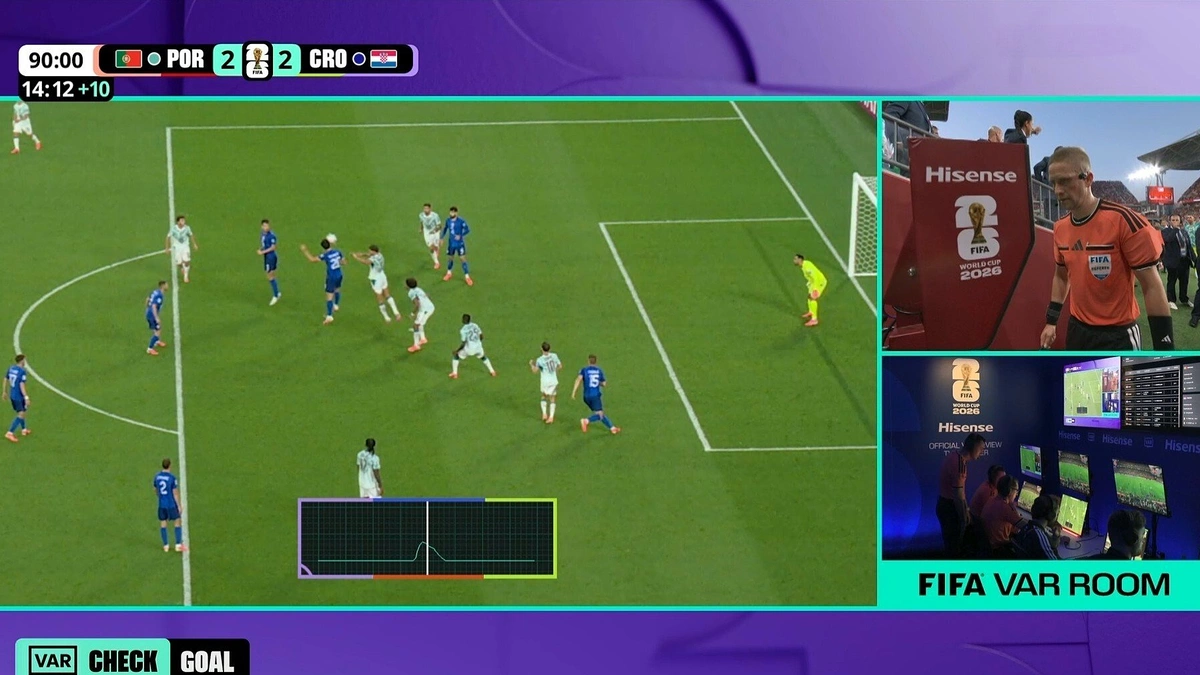
However, the biggest controversy so far at the 2026 World Cup, according to Eurosport, is Croatia's denied goal against Portugal on July 3. As the clock ticked past the 103rd minute of the match, from Ivan Perisic's left cross into the penalty area, the ball flew past players Igor Matanovic, Renato Veiga, Mario Pasalic before Ruben Neves scored an own goal.
However, VAR stepped in to determine whether Matanovic touched the ball or not. If not, the goal is valid. On the contrary, Pasalic was offside and the goal was canceled. Through the super-sensitive sensor in the Trionda ball, the referee determined that the Croatian player had touched the ball, meaning the goal was not recognized.
According to CNN, the unfortunate thing for Croatia is that Matanovic's very small touch of the ball is almost invisible to the naked eye. In previous World Cups, perhaps the goal would have been recognized. But this year, FIFA has applied new technology and the organizers can consider this a big victory.
"It kills emotions, kills everything inside you, what you experience and brings everything back to the starting point. All these decisions take away the joy of football," Zlatko Dalić, head coach of the Croatian team, told TNT Sports. "Solving all the problems is not easy. I agree that football needs to be fair, and decisions need to be fair, but we have gone too far with VAR."
According to Forbes, football is a sport that always welcomes innovation, sometimes reluctantly. In 1992, FIFA applied the back pass rule, stipulating that goalkeepers are not allowed to use their hands to catch the ball when a teammate intentionally uses their feet to pass it back to prevent teams from wasting time and reducing the pace of the match. A decade ago, Goal-line technology was applied, automatically determining whether the ball has completely crossed the goal line or not.
Today, the development of technology helps referees make better decisions. However, the 2026 World Cup is set to become a stage for more driven innovation, including unprecedented levels of AI adoption.
The knockout round matches showed that technology is no longer a secondary factor, but has even become the "main character" of the match. As in the case of the Portugal - Croatia match, the decision was not only focused on the return angles, but also on the data collected by the chip in the ball, detecting the light touch that changes the attack sequence and confirms the offside.
In fact, the application of technology helps overcome mistakes that existed in previous tournaments: goal-line technology eliminates "uncertainty" about whether a goal will be recognized or not; Semi-automatic offside technology shortens wait times while improving consistency; VAR overturns cases of mistaken identity, missed penalties and dangerous fouls that the referee cannot see from an on-field perspective.
"Technically, the system works well. The technology provides information that the naked eye cannot see and allows the referee to apply the law with incredible accuracy," Forbes commented. "However, the difference between a valid and an illegal goal lies in the touch of the ball that almost no one sees, a fundamental interference in the match."
According to experts, technology is bringing positive things both on and off the field. Professor Casper Harteveld of Northeastern University (USA) believes that one of the connections is to help the audience better understand the offside law. The rule prohibits the furthest active attacking player from standing closer to the goal line than the ball, and the penultimate defensive player from standing closer to the goal line than the first player to receive the ball. At this World Cup, 3D images of the players were created partly by AI, helping fans understand why the referee made decisions.
Brennan Klein, lecturer at the Network Science Institute at Northeastern University, assesses the application of AI in football as "inevitable", as the need to collect data from matches, practices and many other activities is increasingly prioritized to create more favorable conditions for analysis. "But if you go to watch a match and the VAR decision takes too long, obvious anger will start to rise, even booing if things are complicated," Klein said.
Stephen Warren, who teaches at Northeastern University's Department of Communication Studies, said using technology requires balance. "What people love about sports is the human element of it," Warren said. "We like to expect the unexpected, because it's played by humans, not machines."
Kuda Muhlauri, a freelance soccer coach in Boston (USA), also believes that technology should only be analyzed at a moderate level instead of paying attention to every detail. According to him, it can take away the excitement of the match and make players hesitate to celebrate a goal before it is confirmed by technology.
According to this coach, technology should only be used to support objective decision-making such as offside or diving. "When you try to control every detail of every play, you lose what makes football a 'beautiful sport'. It's the spontaneity and imperfections that create the beauty of this sport," Muhlauri added.