China launches the world's most powerful solid-fuel rocket
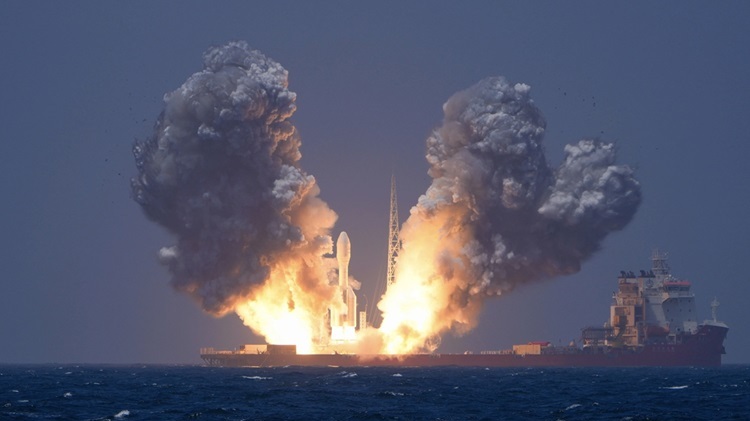
According to Global News, the Gravity-1 rocket developed by Orienspace company launched at 10:54 a.m. on July 22 local time (9:54 a.m. on the same day and time in Hanoi) marking the first time a private commercial rocket was launched offshore. Gravity-1 took off from a launch vehicle operated by the Oriental Aerospace Port in Haiyang, Yantai, Shandong province, under the direction of the Taiyuan Satellite Launch Center. This is China's only commercial maritime launch base and is also where missiles are assembled.
This mission mainly tests the operation of Gravity-1 in offshore conditions, confirming the adaptability of the solid fuel booster configuration in the complex environment at sea as well as maintaining a launch readiness state for a long time before takeoff.

Gravity-1 is the most powerful solid-fuel rocket in the world today. According to Space, the rocket is 30 meters long, weighs 405 tons and has a takeoff thrust of 600 tons. The vehicle can carry 6.5 tons of cargo to low Earth orbit (LEO) and 4.2 tons to Sun-synchronous orbit. Compared to it, SpaceX's Falcon 9 liquid fuel rocket can carry a maximum of 22.8 tons of cargo to LEO.
The satellite cluster that Gravity-1 carried into orbit includes satellites Dongpo-13, Dongpo-14, Dongpo-17 to 20, Xiguang-2 01, Tianyi-49 and Lilac-3. The six Dongpo series satellites include two optical satellites and four synthetic aperture radar (SAR) satellites. According to Science and Technology Daily, after entering orbit, they will combine with four active Dongpo satellites to form an integrated constellation, improving data collection efficiency and spatial range, supporting remote sensing applications in China's southwest region such as land surveying and mapping, emergency response, disaster relief, agriculture, forestry and water resources management.
The Xiguang-2 01 and Tianyi-49 satellites are designed to integrate artificial intelligence, commercial space technology and quantitative remote sensing, providing Earth observation services to customers in the fields of mineral exploration, agriculture and forestry, environmental monitoring and urban planning.
Xiguang-2 01 is Xiopm Space company's first AI computing satellite, integrating hyperspectral quantitative remote sensing with real-time intelligent data processing. Instead of transmitting remote sensing data to ground stations for processing, satellites will collect data, process and make decisions directly in orbit. Meanwhile, Lilac-3 will test the technology in orbit. This is an ultra-flat satellite platform that integrates thermal control functions and new generation direction control technology.
According to CGTN, unlike the previous two launches, which were only a few kilometers from the coast, this time the launch ship moved to an area about 170 km east of Shanghai. Xu Guoguang, lead designer of Gravity-1, shared: "Launching offshore means we have to face completely different conditions. The sea is rough even when there is no wind. We have to plan support for the entire journey in advance."

The choice to launch at sea stems from three main advantages. First is safety, the missile's flight path and debris fall zone are all located in the ocean, with little population and property. Next is efficiency, missiles launched from land must avoid cities and airspace, leading to energy consumption and reduced payload, while launching from sea allows the vehicle to fly directly to the optimal orbit. Third is trajectory flexibility, different missiles require different trajectories and launching from the sea allows freedom to choose launch points based on mission requirements.
According to Xu, launching solid fuel rockets at sea will pave the way for launching liquid fuel rockets in the future. Engineers are also considering other methods such as launching from a drilling rig.