'Vibe coding' makes an application to help vulnerable people

Applications that help look up health insurance benefits, support teachers in highland areas, and warn the blind of obstacles are products made entirely from "commanding" AI, among the top 10 impressive projects shared at the AI Riser Vietnam 2026 - Demo Day event, October 8 in Ho Chi Minh City, organized by Google.
Đây là các dự án nổi bật, được lựa chọn từ hơn 750 dự án đăng ký tham gia chương trình trong năm 2026. Với "đề bài" là sử dụng mô hình Gemini và Google AI Studio để phát triển sản phẩm, người tham gia sẽ sử dụng ngôn ngữ tự nhiên để mô tả điều mình muốn, sau đó AI của Google sẽ cùng tạo, chỉnh sửa mã nguồn cùng người dùng, nhằm tạo ra sản phẩm. Cách thức này còn được gọi là "Vibe coding", từ khoá phổ biến kể từ khi các nền tảng AI tạo sinh hỗ trợ viết code phát triển mạnh.

Thanks to vibe coding, "My Book", the project was completed by Nguyen Quang Phu, a newly graduated engineer, in less than a week. From the idea of helping elementary school teachers in remote areas build intuitive and creative lessons for students, while still ensuring accuracy, Phu used AI to develop a tool to help create learning materials based on knowledge from textbooks. The tool allows teachers to take photos of book pages or handwritten notes, then create illustrated frames, lecture notes and exercises, allowing them to be exported into printed documents for students to use.
"Right place" - Health insurance and medical service lookup application was built by Banh Thi Ngoc Truc, a doctor directly examining and treating patients in Ho Chi Minh City, from real-life problems. The application helps patients look up health insurance benefits, find suitable specialized medical facilities, view contract status, examination hours and reference costs. The product is built on Google AI Studio with Vietnamese commands, allowing Truc to include a series of features that she considers necessary for users, from comparing documents from the Ministry of Health and Social Insurance, to using Google Maps to locate suitable medical facilities.

Meanwhile, SightBridge AI by Pham Van Manh in Hanoi targets more than two million visually impaired people in Vietnam, with the problem of moving between common obstacles on the sidewalk such as parked motorbikes, steps or billboards. The app uses the smartphone's camera to detect obstacles and provide vibration warnings, and has an AI layer in the cloud to answer questions about the surrounding environment. The system also has a fall detection feature and sends location to loved ones via SOS. According to the development team, the application has been tested with visually impaired people when moving on sidewalks and catching buses.
"These projects do not stop at a purely technical level, but are deeply humane solutions, created by Vietnamese talent to solve practical problems," commented Marc Woo, General Director of Google Vietnam.
Vibe coding lowers the barriers to making software
With video coding, product developers, instead of writing each line of code themselves, can describe the application they need to do, communicate with AI and continuously adjust the product according to requirements. This approach is significantly shortening the distance from an idea to a testable application.
According to Manikantan, Head of Google Developer Ecosystem for Asia-Pacific, AI's change in software development is happening in two directions: changing the way and forces involved in building software, and expanding the type of solutions that can be created.
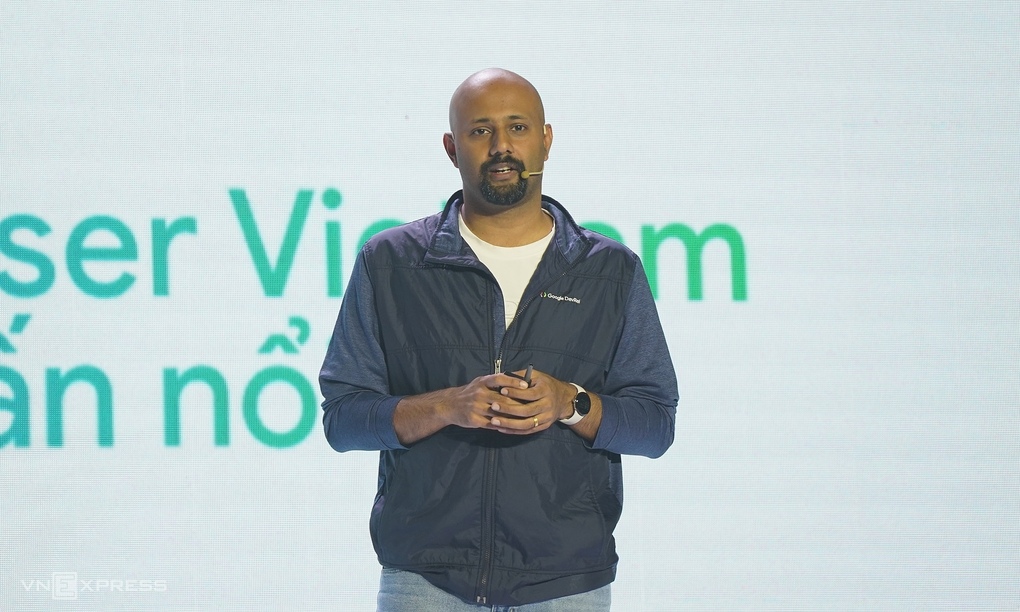
This is clearly shown through projects at AI Riser in Vietnam. The participants are not only programmers but also doctors, nature conservationists, test engineers or people working in other professional fields. With tools like Google AI Studio and the underlying AI model, they can directly test problems they understand well, instead of having to wait for a technical team to turn ideas into products.
In the case of Banh Thi Ngoc Truc, the person who built the "Right Place" application, she is a doctor, interacting daily with patients' questions about insurance benefits, medical examination and treatment facilities or service costs. Instead of just giving the problem to a software development team, she could build an application herself to try to solve the problem.
"When AI helps estimate medical examination and treatment costs and directs people to the appropriate examination place according to their condition, patients can completely focus on health care and recovery with the most comfortable and optimistic mind," she said. "Right Place" is also the application that received the most votes in the top 10 this time.
Similarly, a nature conservationist can build his own digital museum of birds, while a software engineer can use AI to develop tools to assist the blind or diagnose pests for farmers.
Quang Phu, the developer of the "My Books" application, said that with AI, the difference between people with a technical background and ordinary users is no longer simply the ability to write code. According to Phu, if a non-professional already has a good idea, they can start building software very quickly. On the contrary, people with a technical background will have an advantage in realizing ideas and handling the back-end system.
With "My Book", Phu spent about two to three days researching the current situation and forming ideas, then took about a day to complete the application. According to him, the hardest part is not programming but finding a social problem that is specific enough and determining how technology can solve it.
However, just because anyone can make an app doesn't mean everyone can create a complete product. Manikantan said that the applications created in AI Riser are just the beginning. After the prototype is the process of bringing the product to real users, collecting feedback, testing the safety of AI, perfecting the product and finding a suitable operating model.
Referring to the above software as an example of how technology can help the disadvantaged, Mr. Woo said that they are also inspirational stories from young people, and show that Vietnam has passed the stage of discussing AI, entering the stage of building products using AI.
"Software development is no longer the privilege of just a group of technical experts. Anyone with enough determination and motivation can use commands to build extraordinary solutions," he said.
Luu Quy