Post-smartphone AI device race: Humane AI, Rabbit R1 with a history full of "beautiful" failures

If you string together the devices that have been advertised as the "post-smartphone future" over the past few years, you will probably see a strange commonality: almost all of them die according to the same scenario. Launched grandly, was called the invention of the year by several technology magazines, then a few months later there were a series of negative reviews, and finally it was quietly discontinued or sold off. Now it's OpenAI's turn to step into this gamble when in recent days rumors of this startup launching a screenless AI speaker device led by Jony Ive, the person who shaped the entire design language of the iPhone, have spread throughout technology forums. The question worth asking isn't how good this device will look, but rather: why have similar things failed before, and what's the guarantee this time will be different?
Humane AI Battery: the most valuable lesson
The most obvious case is the Humane AI Pin, an AI-integrated lapel pin launching in 2024 for $699 plus a $24 per month subscription fee. On paper, this is a desirable product: the company was founded by two former senior Apple employees, raised more than $230 million from big-name investors in Silicon Valley, and was once honored by Time as one of the best inventions of the year. Nhưng khi sản phẩm thực sự đến tay người dùng, mọi thứ sụp đổ nhanh chóng. The battery only lasts two to four hours, the device often overheats, voice response is slow and often gives incorrect answers, and the laser text projection on the palm is nearly unreadable under bright light. Để rồi, cú đánh cuối cùng là việc nhà sản xuất phải thu hồi hộp sạc vì nguy cơ cháy nổ.
![[IMG]](https://photo2.tinhte.vn/data/attachment-files/2026/07/9061441_Humane-Ai-Pin-Business.jpg)
Humane AI Pin was praised for its idea but then failed in execution when the product encountered too many errors By February 2025, Humane completely shut down the server that operated the device, and sold company assets to HP for $116 million. The important point is that HP only acquired the software and personnel segment, refusing to accept the hardware segment, as a public declaration that the Battery itself was no longer worth anything. A warrior loudly took the stage, then ended without a trumpet or drum filled with pain.
Rabbit R1 and the question no one can answer

Rabbit R1 that TinhTe has on hand to experience At almost the same time, the Rabbit R1, an orange handheld device designed by Teenage Engineering, launched at CES 2024, also faced a similar wave of criticism despite selling 130,000 units thanks to its eye-catching design. The problem is not with the device's appearance but with the core question that nearly every review asks: what can this device do that a smartphone can't?
Review Rabbit R1: smartphones have AI, so why does an AI device exist? I had access to the Rabbit R1 very late since its launch in the US - a time when it created a lot of attention and many mixed opinions surrounding its existence. The development speed of Gen AI is extremely fast and that's why, when I... Tinhte.vn In fact, the Rabbit R1 had difficulty answering basic questions, object recognition through the camera was inaccurate, and application integrations were full of errors and interruptions. What's worse is that there are findings that the device's proprietary software can actually run on regular smartphones. This makes many people question whether this is simply repackaging existing technology in an expensive and less convenient shell, and whether they need to spend money to buy such a device when a smartphone still does its job well?
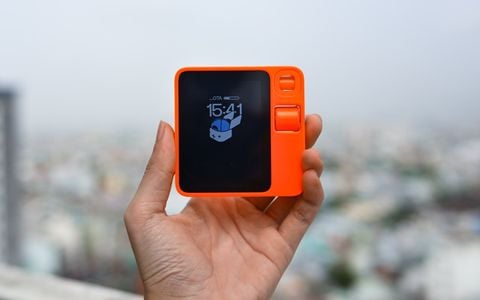
Review Rabbit R1: smartphones have AI, so why does an AI device exist?
ElliQ: a rare case of going in the right direction, but going slowly
To be fair, not every standalone AI device fails miserably. ElliQ, the companion robot for the elderly launched by Intuition Robotics in 2022, still exists today and is even mentioned as a possible inspiration for OpenAI's new device. ElliQ is shaped like a desk lamp, with gentle mechanical movements to create the feeling of listening, actively chatting with users many times a day with jokes or questions, and monitoring health indicators such as heart rate, blood pressure and appointment schedules.

ElliQ exists but with a sensible approach to the needs of the elderly
The problem isn't just hardware
Looking back at all three cases, it is easy to see that the problem is not simply a weak battery or overheating, although these are certainly real technical errors and seriously harm the user experience. The deeper problem lies in the usage model: users have spent more than a decade building habits with smartphones, where every task: from texting, to payments, to smart home control, is encapsulated in a device they always carry. Then, to convince them to bring a second device, the device itself must bring enough value to compensate for the inconvenience of having to remember to carry it, charge it, and learn how to use a completely new interface. Both the Humane Pin and the Rabbit R1 failed to overcome that habit-changing threshold, while expectations inflated by the media before launch made the subsequent fall even more painful.
Can OpenAI avoid the same mistake?
OpenAI's new device, as described by Bloomberg, has some notable differences from previous failed products. This is a fixed home speaker, not a wearable device, meaning it is less constrained by battery and size limitations like the Humane Battery or Rabbit R1. It also does not try to completely replace smartphones but positions itself as a new type of "family computer", closer to the direction that ElliQ once proved to be more feasible: a companion device in the living space, not a device to carry with you. The mechanical parts moving to create a "living" feeling is also an idea borrowed directly from ElliQ, just on a much larger scale and budget thanks to OpenAI's resources.

OpenAI's new device simulation