Turn the Strategic Technology Center into a Vietnam - Australia research platform
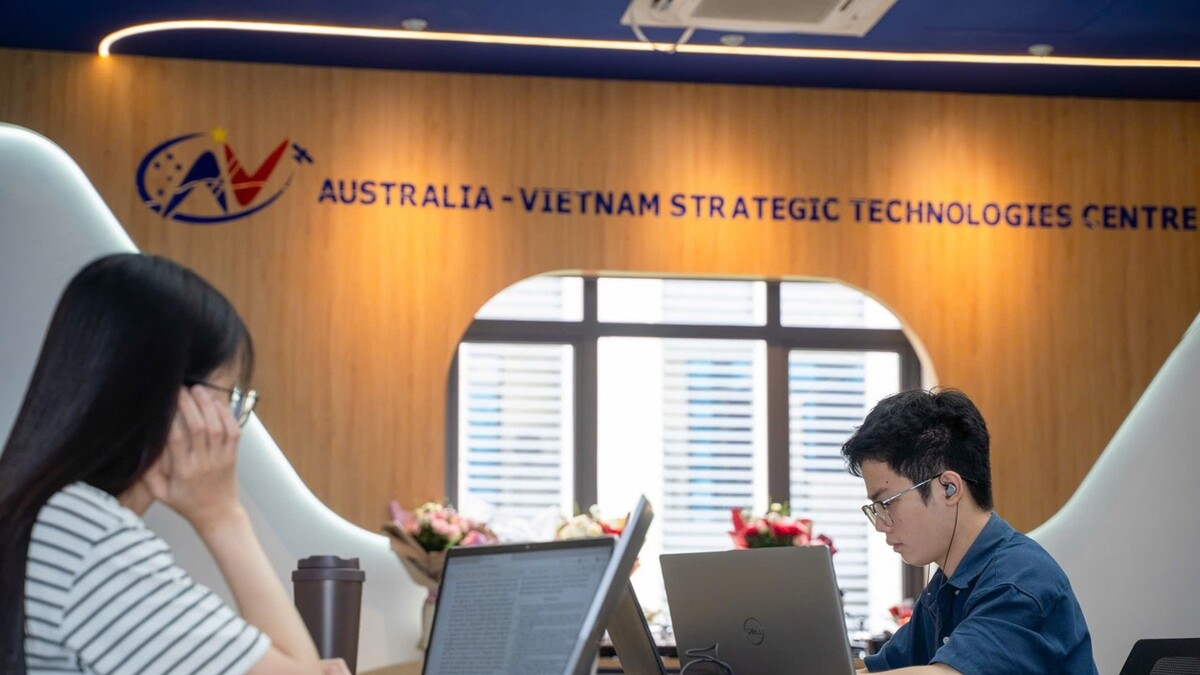
This is one of the directions mentioned many times in technology cooperation between Vietnam and Australia in the upcoming period. In a joint statement on strengthening Science, Technology and Innovation connections between Vietnam and Australia on August 11, leaders of the two countries evaluated AVSTC "as a typical partnership model to promote cooperation on key and emerging technologies, focusing on breakthrough applications of 5G technology and related platform technologies."
"The leaders of the two countries also welcomed the implementation of Phase II of the Vietnam-Australia Strategic Technology Center," the joint statement said.
AVSTC opened in June 2025, implemented through cooperation between the Posts and Telecommunications Institute of Technology (PTIT) and the University of Technology Sydney (UTS), located at the campus at PTIT (Ha Dong, Hanoi). The Center aims to bring together experts from academia, business and the Government of the two countries to solve challenges and seize opportunities from new technology, with focus areas including 5G/6G and new generation networks, AI and machine learning, cybersecurity, data security, quantum technology and digital future.

In a speech at the TechConnect event at the University of Technology Sydney on the morning of August 10, Minister of Science and Technology Vu Hai Quan also emphasized that the two sides need to continue developing the Strategic Technology Center into a common platform, while connecting venture capital funds and technology capital sources so that excellent inventions have the opportunity to go straight from the laboratory to the market.
According to the Minister, units in Australia, including UTS, have had many individual collaborations with schools in Vietnam. However, in the new period, these activities need to be connected into a "common platform", thereby creating a broader collaborative ecosystem instead of separate projects.
Realizing the new role of the Center
At the meeting on August 11, representatives of PTIT and UTS concretized the orientation of turning the Center into a common research platform.
According to PTIT Director Dang Hoai Bac, after more than a year of operation, the Center has formed the initial foundations for research cooperation between the two countries. In the first 14 months, the Center launched eight seed research grants selected from more than 200 applications, providing 100 research grants and 19 awards for women in technology. The series of scientific seminars attracted more than 350 participants, and nine experimental models were developed in areas such as 5G security, AI to protect privacy, remote medicine and Vietnamese sign language translation.
From these results, PTIT and UTS agreed to increase the role of the Center, not only as a place to implement joint research projects but gradually becoming a platform connecting scientists, universities, businesses and management agencies of the two countries.
The two sides plan to identify priority technology areas, find suitable partners for each research direction and perfect the Center's management model. One emphasized content is creating a mechanism for businesses to participate more deeply in the process of problem solving, research, testing and technology application.

One of the directions discussed by PTIT and UTS is to deploy the UTS Rapido model through the Center. This is UTS's applied R&D model, connecting researchers with businesses to develop technology from ideas, testing to prototypes and practical applications. If deployed in Vietnam, this model can add a link between research and the market, helping businesses bring actual needs to research groups, while creating opportunities for potential results to reach technical partners, capital sources and customers.
In the next stage, quantum communications and 6G are mentioned by both sides as directions that can promote cooperation. These are all new technology fields, requiring the participation of many parties and long-term research resources, consistent with the connection model that the Center is aiming for.
In addition to technology research and commercialization, cooperation in human resource training is also a focus that is expected to be expanded in the near future. At the meeting, the two sides said they would research joint training programs based on business needs, joint programs, dual degrees and skills training. A specific proposal is to build a certificate program on artificial intelligence jointly implemented by PTIT and UTS, combining face-to-face training in Vietnam with online participation from UTS experts.
Professor Andrew Parfitt, Rector of UTS, highly appreciated the results of cooperation with PTIT and agreed with the direction of developing the Center into a foundation for more extensive cooperation activities. UTS also shares strengths in areas such as digital economy, digital finance, infrastructure, supply chain management and network resilience, opening up additional avenues of cooperation besides strategic technology.
Luu Quy