Tomorrow there will be a rare total solar eclipse
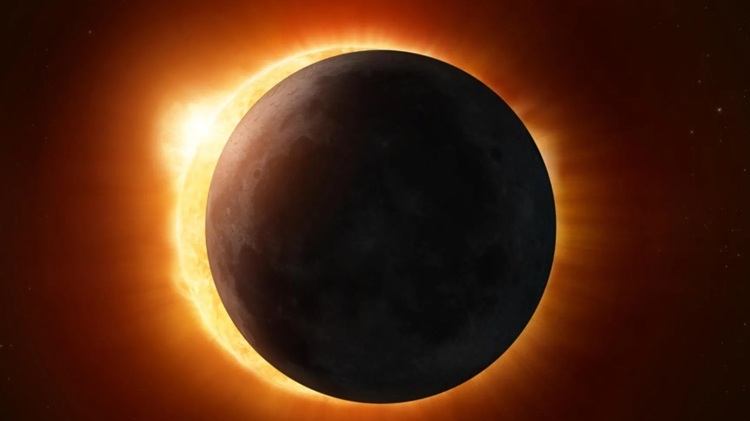
According to the Hanoi Astronomical Society (HAS), the total solar eclipse will take place on the night of August 12 and early morning of August 13 (Hanoi time), but Vietnam is completely outside the observation area of this eclipse. Meanwhile, many places in Europe will briefly go dark as the continent experiences the first total solar eclipse in nearly 3 decades (since 1999).
According to Sky News, places in the path of totality will be in darkness. This band is 100 to 200 km wide on Earth's surface where the Moon's shadow sweeps across, turning day into twilight when the Moon completely obscures the Sun. Specifically, people in northern Russia, Greenland, Iceland, Spain and a small corner of Portugal will have the opportunity to admire the total solar eclipse. Britain and Ireland will experience a partial solar eclipse, when the Moon obscures between 90% and 96% of the Sun, creating a deep twilight effect rather than complete darkness. Meanwhile, people in the northern US from Alaska to North Carolina will see a partial eclipse.
According to the New York Times, a total solar eclipse occurs when the Moon is between the Earth and the Sun, temporarily obscuring the Sun's surface from view from the ground. This creates a dark disk in the sky, surrounded by a faint halo of light from the Sun's outer atmosphere called the corona. The Moon is about 400 times smaller than the Sun, but it is also about 400 times closer to Earth, making both appear the same size in the sky. For a total solar eclipse to occur, the Sun, Moon and Earth must be perfectly aligned in space.
The shadow of the Moon caused by this alignment has an inner part called the umbra. People below the umbra, where it carves out a relatively narrow path on Earth, will experience the full spectrum. People under the penumbra, or outer part of the Moon's shadow, will see a partial eclipse, in which the Moon covers only part of the Sun's surface.
The event on August 12 will begin with a partial solar eclipse lasting about an hour. The Moon will press on the edge of the Sun and gradually obscure its surface. This is followed by a short total phase. Then the Sun emerged from the Moon. In total, the phases of the eclipse last about two hours.
According to the Guardian, after noon on August 12, two NASA pilots will control a research aircraft to take off from Keflavik airport on the western tip of Iceland to take pictures of the Sun while flying along the path of the eclipse. The plane will fly north toward Greenland, then circle south in a 64-kilometer arc off the coast of Iceland.
Although this is a mission to chase the eclipse, in fact while the plane glides at an altitude of 15,000 m, the shadow of the Moon will chase behind, across the ocean below at a speed of more than 3,200 km/h. The pilot will aim to fly to the peak of the eclipse (the moment when the Moon obscures most of the Sun) just as darkness overtakes the plane. Through data from photos of the Sun, scientists can learn more about space weather, charged particles and radiation that can pose threats to astronauts, satellites, power grids and communications networks on Earth.