China's reusable rocket successfully flew into orbit
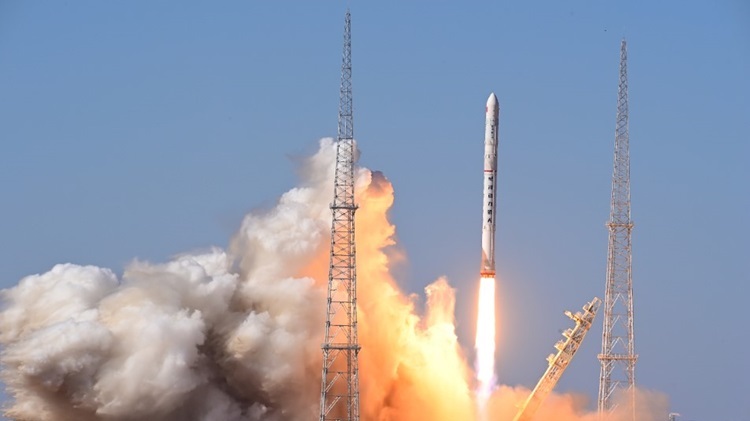
Global Times reported that the Pallas-1 Y1 rocket took off at 10:00 a.m. on September 1 from the launch pad dedicated to the Pallas series at the Dongfeng Commercial Space Innovation Pilot Area in Jiuquan, northwest China. The rocket flew according to plan to a predetermined orbit and completed its mission successfully.
Pallas-1 is one of Galactic Energy's core launch vehicles designed to deploy low-orbit satellite constellations and launch relatively large spacecraft. This two-stage rocket is 52 m long and has a core diameter of 3.35 m, a takeoff mass of about 283 tons and a thrust of about 350 tons, with the option of installing an additional upper stage. The vehicle can carry 5-7 tons of cargo into low Earth orbit, suitable for current satellite constellation deployment missions.
Galactic Energy wants to turn Pallas into a high-performance, low-cost booster for commercial satellite operators. According to Space, like SpaceX's Falcon 9 rocket, Pallas-1's first stage is reusable, designed to fly 25 times. Pallas-1's thruster will fly back to Earth with the help of net wings and land with landing gear.
The key part of Pallas-1 is the propulsion system. The first stage of the vehicle uses energy from 7 CQ-50 engines running on liquid oxygen fuel - kerosene developed by Galactic Energy. This is the first Chinese private company to apply such a 7-engine cluster configuration. This configuration provides ample thrust while also meeting first stage recovery requirements. According to the company, if one engine has a problem during a certain phase of flight, the remaining 6 engines are still capable of adjusting to increase power to compensate, thereby increasing the overall reliability of the system.
The CQ-50 is an engine that uses a pin injector designed specifically for reuse. Ground testing demonstrated that the CQ-50 has the ability to flexibly adjust depth thrust (change power) in the range from 32% to 105% compared to rated thrust as well as launch multiple times, making an important contribution to controlling the return flight thrust stage during deceleration and landing. The CQ-50 engine has undergone more than 23,000 seconds of ground firing tests.
Galactic Energy is approaching first stage recovery step by step instead of trying to both launch the rocket into orbit and recover the booster stage on the first flight. Pallas-1's launch mission is focused on achieving its orbital goal and collecting comprehensive data to verify the overall performance of the rocket's propulsion, control and structure systems, the company said.
Pang Zhihao, a space expert who worked as a researcher at the Academy of Space Technology, said that Pallas-1's successful entry into orbit marked an important step forward for China's commercial space industry, as a medium- and large-sized liquid-fueled rocket developed by a private company completed a basic validation flight to collect original data.
From an industry perspective, the mission sees Galactic Energy transition from a launch services provider focused on solid-fuel rockets to the market for medium- and large-sized liquid-fueled rockets, reusable launch systems and low-orbit satellite constellation deployments. Galactic Energy will compete directly with other private Chinese rocket developers also pursuing the goal of reducing costs and increasing the frequency of flights to orbit.
In subsequent launches, Galactic Energy plans to test technology including reentry control with the first stage, net wing operation, braking and deceleration, as well as recovery at sea or on land, before moving on to full vertical landing testing. Once the above technologies are perfected, the company will reuse them with higher frequency and commercial operations, focusing on simplifying inspection and refurbishment, reducing reuse costs and shortening turnaround times between flights.
According to SCMP, Galactic Energy was founded in 2018 by Dr. Liu Baiqi and several other aerospace engineers. To date, Galactic Energy has performed 22 successful orbit launches and transported 89 commercial satellites with many different functions.
Reusable rocket development is accelerating in China's commercial aerospace industry. On August 19, private aerospace company LandSpace launched the Zhuque-3 Y2 reusable booster rocket. The second stage put the Honghu-03 satellite into a predetermined orbit while the first stage deployed the landing gear for recovery on the ground. This is the first time China has successfully recovered the first stage of a land-based orbital rocket with such a landing gear.